
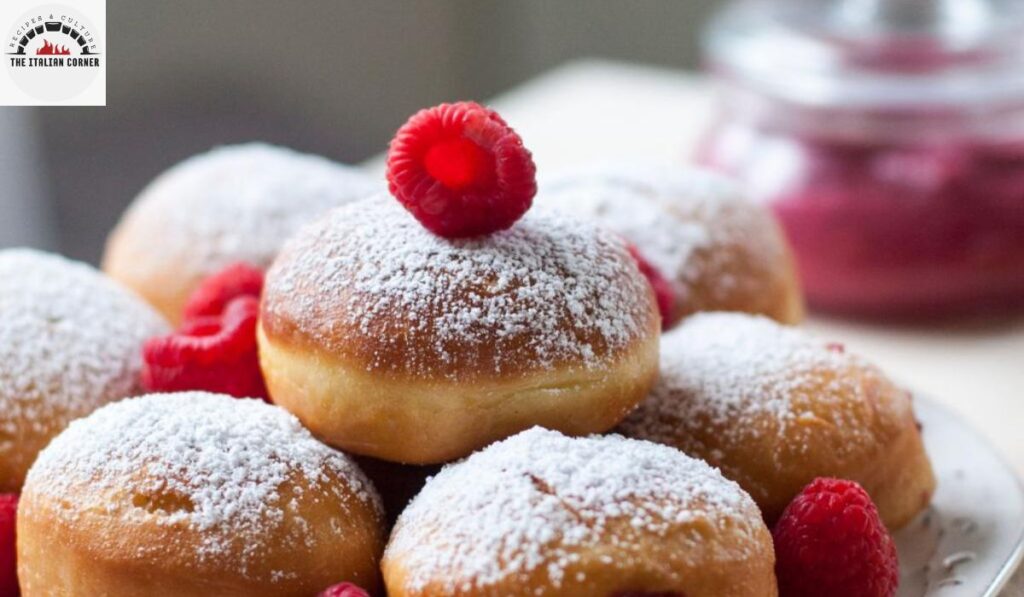

There’s a stretch of about eighteen months in my career where I would not let anyone else near the fryer when raspberry bomboloni were on the pastry section. Not because I didn’t trust the apprentices — because I’d blown three batches myself in one week and wasn’t in the mood to explain a fourth to the head chef.
Bomboloni look like a doughnut. They are not a doughnut, and treating the dough like one is exactly how you end up with something dense, greasy, and sad by the time it hits the raspberry filling. Get the dough right and it’s the lightest thing that will ever come out of hot oil in your kitchen. Get it wrong and you’ve made an expensive brioche-flavoured rock.
Why This Version Actually Works
Most bomboloni recipes online read like doughnut recipes with an Italian name stapled on. Wrong hydration, wrong proof, and a filling method that pumps jam into the middle of a ball with no structure to hold it, so it either sinks to the bottom or blows straight out the side the second you bite in.
This version is built the way I was taught to build it on the pastry section — enriched dough, properly proofed twice, fried lower and slower than feels right, then filled through a small, precise hole with a raspberry filling that’s been reduced enough to actually hold its shape inside the dough. No shortcuts on the proofing. That’s the one step everyone tries to skip, and it’s the one step that decides whether you get a cloud or a brick.
The Technique That Makes or Breaks It
Everything comes down to oil temperature, and it’s the opposite of what people assume. Home cooks fry hot because they’re impatient and it looks done faster. Bomboloni need to go in at around 170–175°C, lower than a standard doughnut. Any hotter and the outside colours before the inside has cooked through, so you get a dark, ready-looking ball that’s raw dough in the centre. I plated exactly that mistake for a table of six once, and I still remember the silence when the first one got cut open.
Low and slow gives the dough time to actually cook all the way through while the outside goes an even, deep gold — not the blistered, too-fast brown you get from oil that’s run too hot.
Ingredients (Makes about 16)
For the dough:
- 500g strong bread flour (00 flour works too, if your Italian deli stocks it)
- 80g caster sugar
- 7g instant yeast
- 250ml full-cream milk, warmed to just above room temperature
- 2 eggs
- 60g unsalted butter, softened
- 1 tsp salt
- Zest of 1 lemon
- Neutral oil for frying (rice bran or vegetable — not olive oil, it’ll smoke and taste wrong)
For the raspberry filling:
- 400g fresh or frozen raspberries
- 100g caster sugar
- 1 tbsp lemon juice
- 1 tsp cornflour, mixed with a splash of water
To finish:
- Caster sugar, for rolling
Method
1. Build the dough. Whisk the warm milk, yeast, and a pinch of the sugar together, and leave it for 5 minutes until it’s foamy on top. If it doesn’t foam, your yeast is dead — start again rather than pushing forward with dough that won’t rise.
2. Mix and knead. Combine the flour, remaining sugar, salt, and lemon zest in a large bowl. Add the eggs and the yeast mixture, and bring it together into a rough dough. Knead in the butter a little at a time — it’ll look like a mess for a few minutes before it comes together into something smooth and elastic. This takes a good 10 minutes by hand, less in a stand mixer, but don’t rush it. Under-kneaded dough is the second most common reason bomboloni turn out dense.
3. First proof. Cover and leave somewhere warm until doubled in size — about 1.5 hours, though this depends entirely on how warm your kitchen actually is. Don’t proof by the clock; proof by size.
4. Shape. Punch the dough down, divide into 16 even pieces, and roll each one into a tight ball, tucking the seam underneath. Place them on a tray lined with baking paper, spaced well apart.
5. Second proof. Cover loosely and leave for another 45 minutes to an hour, until visibly puffy. This step is the one everyone tries to skip. Don’t. It’s the difference between a light, airy bombolone and a dense one that just happens to be fried.
6. Fry. Heat the oil to 170–175°C — a thermometer isn’t optional here, guessing gets you inconsistent results every time. Fry in small batches, 2–3 minutes per side, until deep golden all over. Drain on paper towel and roll immediately in caster sugar while still warm — the sugar won’t stick once they’ve cooled.
7. Make the filling. Cook the raspberries, sugar, and lemon juice in a small saucepan over medium heat until the berries break down, about 8 minutes. Stir in the cornflour mixture and cook for another minute until it thickens enough to hold a line on the back of a spoon. Push through a sieve if you want it seedless, then cool completely before filling — warm filling turns the inside of the dough gummy.
8. Fill. Once the bomboloni are fully cool, use a piping bag with a narrow nozzle to push it into the side of each one, right into the centre. You’ll feel the weight change in your hand as it fills — that’s your cue to stop, not a timer or a count.
Chef’s Notes
- If your filling leaks straight back out the hole, it wasn’t reduced enough. It needs to hold its shape on a spoon before it goes anywhere near a piping bag.
- These are best eaten within a few hours of frying. The sugar coating goes tacky and the dough loses its lightness by the next day — this isn’t a make-ahead pastry, and no amount of storage trickery changes that.
- If you don’t have a thermometer, drop a small offcut of dough into the oil. It should sink slightly, then rise and bubble steadily — not violently.
- Frozen raspberries work just as well as fresh for the filling, and honestly, out of season, they’re the more reliable choice.