
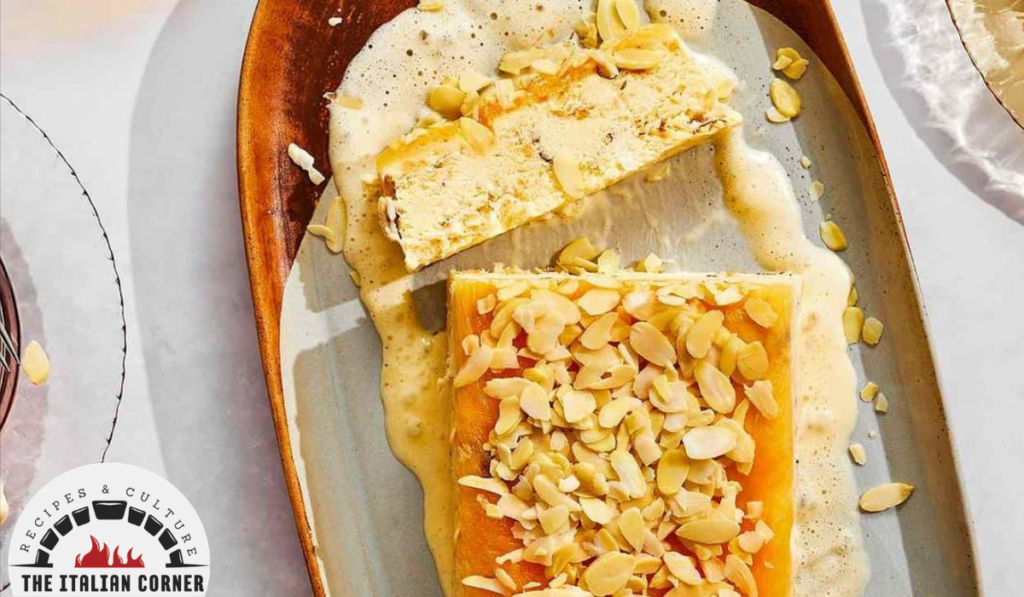

My first Christmas Day off in six years of cooking, I volunteered to bring dessert — and then panicked, because a chef’s family expects a miracle and a 38-degree Adelaide December kills pavlova cream by 1 pm. What I brought was what our pastry section made all summer for exactly this problem: a semifreddo. Sliced straight from the freezer onto the table, honey and roasted almonds through it, standing up to the heat for the twenty minutes it needed to before disappearing. My aunt still calls it “the fancy ice cream.” She’s not wrong. She’s not right either.
Semifreddo means “half-cold,” and it’s the smartest dessert Italy ever put in a freezer: all the luxury of gelato, none of the machine, made entirely the day (or the week) before. If you cook in Australia — where Christmas is hot, entertaining is summer, and nobody wants to plate dessert at 9 pm — this should be in your repertoire ahead of ice cream itself.
What semifreddo actually is
It’s a frozen mousse. Not ice cream, though it lives next door. Ice cream is churned — a machine beats air in while it freezes, and that air keeps it scoopable. Semifreddo gets its air before freezing instead: you whip air into egg yolks and sugar, whip more into cream, fold them together, and freeze the foam in a loaf tin. No churning, no machine, no stirring every hour like those miserable “no-churn” hacks that come out as sweet ice bricks. The texture lands between gelato and mousse — colder than one, silkier than the other — and it slices like a terrine, which is why restaurants love it: portioned in seconds, plated in advance, always perfect.
The technique: air is your antifreeze
Here’s what’s actually happening in the freezer, because once you understand it, semifreddo becomes nearly impossible to ruin.
Water freezes into crystals; crystals are the crunch in bad frozen desserts. Semifreddo fights the crystals with three weapons at once. Fat (cream, yolks) coats and interrupts them. Sugar lowers the freezing point, so less of the water freezes solid at all. Air — millions of whipped-in bubbles — physically breaks up the frozen structure, the way bubbles make an Aero bar snap softly instead of like toffee. Get generous amounts of all three into the mix and the result freezes smooth and slices cleanly at −18°C, no churning required. Skimp on any of them — low-fat cream, cutting the sugar, lazy whipping, or the cardinal sin, stirring the air back out when you fold — and you’re back to a brick.
So the three rules, plainly:
- Whip the yolks over heat until they ribbon. Yolks, honey and sugar whisked in a bowl over barely simmering water until the mixture is thick, pale, warm and falls off the whisk in a slow ribbon that sits on the surface a second before sinking. This is a pâte à bombe, and the gentle heat does two jobs: it stabilises the foam so it survives freezing, and it cooks the yolks to safe. Then whisk off the heat until cool — non-negotiable, because warm yolk mix murders whipped cream on contact.
- Whip the cream to soft peaks only. Soft, drooping peaks fold in like a dream. Stiff cream fights the fold, and overwhipped cream turns the finished semifreddo faintly grainy.
- Fold, don’t stir. Big, slow strokes with a spatula, cutting down through the middle and turning the bowl. The air you whipped in over the last twenty minutes is the entire texture. Every brisk stir deflates dessert.
Honey and roasted almond semifreddo
The one I carry to Christmas. Loosely in the tradition of semifreddo al torroncino — the flavours of torrone, the honey-almond nougat, in frozen form. Six ingredients, one loaf tin, done a week ahead.
Serves 8–10, in a standard loaf tin
- 5 egg yolks (fresh, free-range)
- 100 g honey — a good floral one; the honey is the voice of the dish, so use one you’d eat off the spoon
- 50 g caster sugar
- Pinch of fine salt
- 600 ml thickened cream, cold (thickened — our everyday whipping cream — is exactly right here; don’t buy anything fancier)
- 1 tsp vanilla extract
- 150 g roasted almonds, roughly smashed — buy them roasted and salted, and yes, the salt is deliberate
- 50 g extra honey, for the ripple and to serve
Method
- Line the loaf tin with two layers of cling film, leaving generous overhang — this is how you’ll lift it out later, so be generous.
- Set a heatproof bowl over a saucepan of barely simmering water (bowl not touching the water). In it, whisk the yolks, honey, sugar and salt constantly for 5–8 minutes, until the mixture is thick, pale gold and warm, and ribbons off the whisk. Electric beaters make this painless; by hand it’s an honest forearm workout.
- Take the bowl off the heat and keep whisking until it’s cooled to room temperature and gone thick and moussey — another 3–4 minutes with beaters. Patience here; warm mix ruins the next step.
- In a separate bowl, whip the cold cream with the vanilla to soft, floppy peaks.
- Fold a third of the cream into the yolk mixture to loosen it, then fold in the rest with big, slow strokes until no streaks remain. Fold through most of the smashed almonds.
- Pour half into the tin, drizzle with honey, add the rest, drizzle again and drag a skewer once through for a ripple. Scatter the reserved almonds on what is currently the top (it becomes the base — bonus crunch). Fold the cling film over, and freeze at least 6 hours, ideally overnight.
- To serve: lift it out by the overhang, invert onto a cold plate, peel off the film. Slice with a hot dry knife into thick slabs, thread of honey over each, and get it to the table — the first slice should be firm at the centre and just starting to gloss at the edges. That gloss is the “half-cold” the name promises. It’s the best bite.
Chef’s notes — the honest bits
It holds a month in the freezer, wrapped well — which means Christmas dessert can be finished in the first week of December while you’re still feeling organised. This is the single most useful fact in this article.
Raw-ish egg reality: the warm-whisking cooks the yolks gently, but if you’re serving anyone pregnant or immune-compromised, whisk the mixture until it reaches 71°C on a thermometer and hold it there a few seconds. Costs you nothing; whisk a little longer.
If it froze icy, the mix deflated — usually a warm yolk base hitting the cream, or vigorous stirring at the fold. It’s still delicious blitzed into a milkshake. Ask me how I know.
Flavour it like an Italian, not a showbag. One or two flavours, no more: raspberries rippled through, espresso and crushed amaretti, lemon zest and limoncello, dark chocolate shards. The foam is delicate — chunky, heavy add-ins sink and icy fruit purées streak it with crystals, so ripple purées through, don’t fold them in.
Slices beat scoops. Semifreddo is served in slabs, not balls — softer than ice cream, it collapses under a scoop. The loaf tin isn’t a compromise; it’s the tradition, and it plates faster anyway.
Master the ribbon, the soft peak and the fold, and you’ve quietly learned the base of half of Italian pastry — the same three moves run through zabaglione, tiramisu and mousse. But those are other Sundays.