
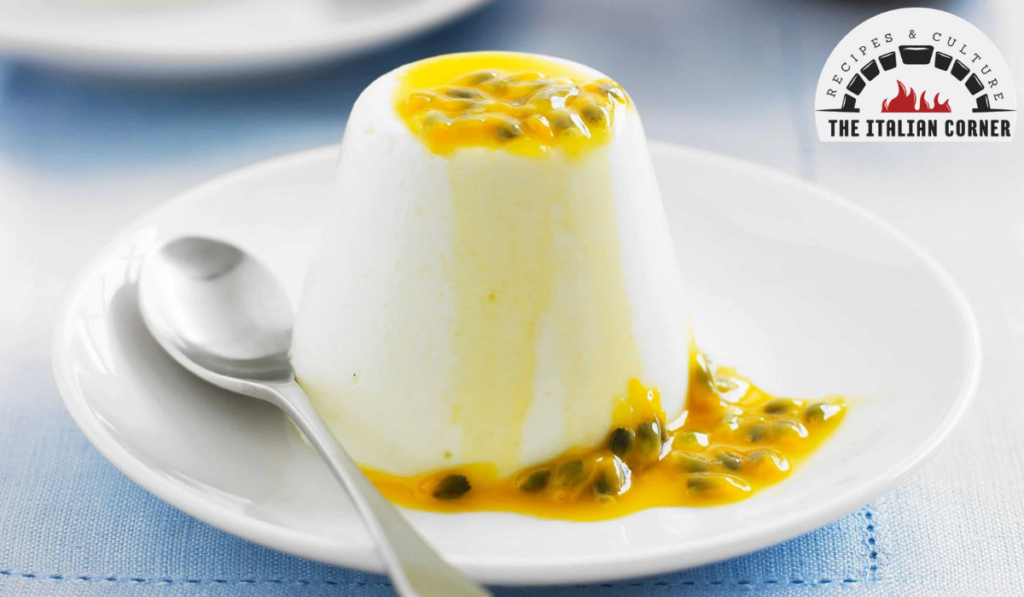

Our head chef judged panna cotta without a spoon. He’d put the plate on the pass and slap the bench beside it, once, like a wrestling referee. If the panna cotta shivered — a slow, indecent, custard-coloured tremble — it went to the dining room. If it stood there like a hockey puck, it went in the bin and someone (me, the first four times) remade the batch with less gelatine. “I can’t taste it if I can bounce it,” he said. He was right, and that sentence is the entire dish.
Panna cotta means “cooked cream,” which oversells the cooking — the cream barely simmers — and undersells the dish. Done right, it’s the most elegant thing you can make with ten minutes of actual work: cream that holds its shape by the width of a hair and collapses into silk the moment it’s touched. Done wrong, it’s a rubber dome. The distance between the two is about two grams of gelatine.
Why panna cotta earns its place
It’s the professional kitchen’s favourite dessert for reasons that transfer straight to your dinner party: it’s made entirely the day before, it plates in thirty seconds, it costs a few dollars of cream, and it carries whatever the season hands you — passionfruit in summer, poached rhubarb in winter, roasted strawberries in spring. When I worked events, panna cotta fed three hundred people without a single à-la-minute step. Your table of six is not going to frighten it.
One position, plainly: panna cotta should be unmoulded. Set in a pretty glass it’s perfectly nice — and it’s also hiding. The naked, quivering dome on a plate is the dish declaring it was made properly, and the first slap-the-table wobble is half the pleasure. I’ll give the glass to nerves on a first attempt. After that, turn it out.
The technique: gelatine is scaffolding, not cement
Here’s what’s actually happening inside a panna cotta, because once you see it, the hockey puck never happens again.
Gelatine is collagen — long protein strands that, as the cream cools, link up into a loose three-dimensional net that traps the liquid and holds it still. The strength of that net scales directly with how much gelatine you use. A little past “just enough” and the net tightens from scaffold to cage: the cream stops melting on your tongue and starts resisting it. That’s the bounce. And because every recipe writer fears their dessert collapsing on a reader, most recipes overshoot on purpose. Insurance for them, rubber for you. As a home cook I trusted the packet directions — which are written to set a firm jelly, a different job entirely — and made confident hockey pucks for years.
The rules:
- Use the minimum, measured properly. For 600 ml of dairy, 3 gold-strength gelatine leaves or 6 g of powdered gelatine (about 2 level teaspoons of McKenzie’s, the orange box at Woolies and Coles) gives the slow-wobble set for an unmoulded panna cotta. Weigh the powder if you can; teaspoons of gelatine are approximate and this dish lives on two grams either way.
- Bloom it, always. Leaves soak in cold water five minutes until floppy; powder gets sprinkled over 3 tablespoons of cold water and left five minutes to swell into a sponge. Blooming lets the gelatine dissolve evenly — unbloomed powder thrown at hot cream forms little pearls that never dissolve, and you find them later, like tiny unpleasant surprises.
- Never boil the gelatine. Heat the cream, take it off the heat, then stir the bloomed gelatine in — the residual heat dissolves it completely. A hard boil weakens gelatine’s setting power, which leads to panicked re-batching, which leads to overdosing, which leads to the puck. The failure cycle starts at the boil.
Vanilla panna cotta with passionfruit
The classic, with the most Australian finish there is — passionfruit’s acidity cutting straight through the cream. Nothing else needed.
Serves 6
- 450 ml thickened cream
- 150 ml full-cream milk (all cream sets richer but heavier; this ratio is the silk point)
- 70 g caster sugar
- 1 vanilla bean, split and scraped — or 2 tsp of good vanilla bean paste; the black seeds are the signature, so skip plain extract here
- 3 gold-strength gelatine leaves, or 6 g powdered gelatine, bloomed (see above)
- Pinch of fine salt
- 4–6 passionfruit — wrinkly ones, which are ripe ones
- 6 dariole moulds, ramekins, or in honest truth a muffin tin lightly greased with a neutral oil
Method
- Bloom the gelatine.
- Warm the cream, milk, sugar, salt, and the vanilla bean and its seeds in a saucepan over medium heat until it steams and the first bubbles appear at the edge — a shiver, not a boil. Off the heat. Lid on, ten minutes, letting the vanilla steep.
- Fish out the pod, then stir in the bloomed gelatine (squeezed of water, if leaves) until completely dissolved — thirty seconds of stirring, no grains on the spoon.
- Now the seed trick: pour the mixture into a jug and stir it over a bowl of iced water until it cools and just begins to thicken, like cold pouring cream. This is what suspends the vanilla seeds evenly instead of letting them sink into a black layer at the bottom. Five impatient minutes. Worth it — the even speckle is how a pastry chef reads another pastry chef’s work.
- Pour into the moulds, cover, and refrigerate at least 5 hours, ideally overnight.
- To unmould: dip each mould in hot tap water for five seconds — count them, five, not ten — run a thin knife tip around the top edge, invert onto the plate, and give one sharp downward shake. It lands with a soft slap. Halve the passionfruit and spoon the pulp straight over and around. Slap the bench once, for tradition.
Chef’s notes — the honest bits
If it didn’t come out of the mould, five more seconds in the hot water. If the sides melted glossy, you gave it fifteen. The hot-water dip is the highest-stakes five seconds in this dessert, and everyone overcooks it exactly once.
If it didn’t set at all: the cream was boiling when the gelatine went in, or the bloom was skipped. It’s now the world’s most luxurious pouring custard — serve it over the passionfruit in glasses and name it something French. No one will know. I have done this at a wedding.
Setting time is real time. Five hours minimum, and overnight is better — gelatine keeps strengthening for the first day. The corollary: panna cotta made two days ahead is slightly firmer than made one day ahead. If you’re prepping early, pull half a gram of gelatine back.
Flavour swaps ride on the same base: steep the cream with espresso beans, lemon zest, or bay leaves (genuinely — bay panna cotta with roasted peaches is a restaurant trick worth stealing). Keep the gelatine identical; only the steeping changes.
Buttermilk move for summer: replace the milk with buttermilk, stirred in off the heat, and the whole dessert turns bright and faintly tangy — the best version for a 35-degree evening, and the one I’d serve with mango.
Minimum scaffold, gentle heat, one confident shake of the plate. That tremble on the pass is the difference between cooked cream and panna cotta — and now it’s yours to slap the table over.