
The pastry chef who taught me tiramisu counted the dip out loud. Every ladyfinger, both sides: “uno… due” — in, turned, out — and if you lingered, she’d take the biscuit from your hand and drop it in the bin. I thought she was performing. Then I remembered every tiramisu I’d made at home before that kitchen: I used to soak the biscuits, really let them drink, because more coffee surely meant more flavour. What it meant was a beige puddle with a skin of cocoa on top. Sludge. Her counting wasn’t theatre. It was the whole dessert.
Tiramisu is the most famous Italian dessert on earth and one of the most reliably botched, and it fails at home for exactly two reasons: the biscuits get drowned, or the mascarpone gets beaten to death. Fix those two and it’s honestly one of the easiest impressive things you can make — no oven, no machine, better tomorrow than today.
What tiramisu actually is
Layers of savoiardi — the dry, rigid Italian sponge fingers — dipped in espresso, between clouds of a mascarpone cream lightened with whipped zabaglione, dusted thick with cocoa. That’s it. It’s young, as classics go — Treviso, in the Veneto, in the late 1960s — which explains why nonnas argue about the “right” version at a volume usually reserved for football. The name means “pick me up”: the espresso and the sugar are the point. It is not a boozy trifle, it is not a cheesecake, and — the first hill I’ll die on today — it is not made with thin cream and cream cheese because the supermarket was out of mascarpone. Mascarpone is the dish.
The technique: two fragile things, handled gently
Here’s what’s actually happening, because both failure points are the same failure — overworking something delicate.
The biscuit is a sponge with a limit. A savoiardo is baked bone-dry so it can absorb coffee and then keep absorbing moisture from the cream around it for the next twelve hours. That’s the design: it goes into the dish still firm at the core and finishes softening overnight. Dip it until it feels soaked and it has nowhere left to go but sludge — all the liquid it took on weeps out into the layers as it sits. So: one second per side. In, turn, out. The biscuit should feel damp at the surface, dry inside, and faintly ridiculous, like it can’t possibly be enough. It’s enough. The fridge does the rest.
Mascarpone is butter pretending to be cheese. It’s around 40 per cent fat, and like cream, it whips — and over-whips. Beat it hard or long and the fat clumps, the texture turns grainy, and shortly after that it splits into something resembling ricotta in a bad mood. The professional habit: mascarpone comes out of the fridge just before use, gets loosened with a few strokes, and everything else is folded into it. The lightness of tiramisu doesn’t come from whipping the mascarpone; it comes from the airy things — the zabaglione and the whipped cream — folded through it with the same big, slow strokes I bang on about in the semifreddo post. Same physics. Air in, air stays in, dessert stays silk.
And the third rule, the one nobody wants to hear: overnight in the fridge. Not four hours. Overnight. The layers need the time to become one thing.
Tiramisu
The version I’d make for the pastry chef who counted. Zabaglione base whisked warm over water — stable, safe, silkier than raw yolks — mascarpone folded, cream folded, one-second dips, thick cocoa lid.
Serves 8, in a roughly 28 × 20 cm dish
- 4 egg yolks
- 100 g caster sugar
- 60 ml Marsala (from the bottle shop’s fortified shelf) — or skip it; the dessert survives, though it loses its grown-up edge
- 500 g mascarpone, cold — full tubs at Woolies and Coles, usually near the fancy cheese
- 300 ml thickened cream, whipped to soft floppy peaks
- 300 ml strong coffee, cooled — moka pot or espresso machine ideally; a strong plunger works; if it’s instant, make it double-strength and we’ll never speak of it again
- 1 packet (about 400 g needs — buy two of the 200 g) savoiardi sponge fingers — Italian brands in the biscuit or Italian aisle; the soft “sponge finger” cake-style ones are the wrong biscuit and turn to mush
- 2 tbsp good cocoa, for a serious dusting
- Dark chocolate, for grating (optional, correct)
Method
- The zabaglione: whisk the yolks, sugar and Marsala in a heatproof bowl set over barely simmering water (bowl clear of the water) for 5–8 minutes, until thick, pale and warm — it should ribbon off the whisk and sit on the surface a moment. Off the heat, whisk another couple of minutes to cool it down. Warm zabaglione hitting mascarpone is how splitting starts.
- In a big bowl, loosen the cold mascarpone with a spatula — ten strokes, no more. Fold in the cooled zabaglione in two additions, then the whipped cream in two more, big slow strokes, until just smooth. Stop the moment the streaks vanish. It should hold its shape softly on the spatula, like something you’d want to fall asleep in.
- Pour the cooled coffee into a shallow bowl. Now the count: one biscuit at a time — in, turn, out, “uno, due” — and straight into the dish. Lay a full layer, trimming a biscuit or two to fill gaps.
- Spread over half the mascarpone cream, right to the edges. Second layer of counted biscuits. Rest of the cream, smoothed flat or swooped with the back of a spoon if you like it rustic.
- Cover and refrigerate overnight — 12 hours is the sweet spot, 24 is even better.
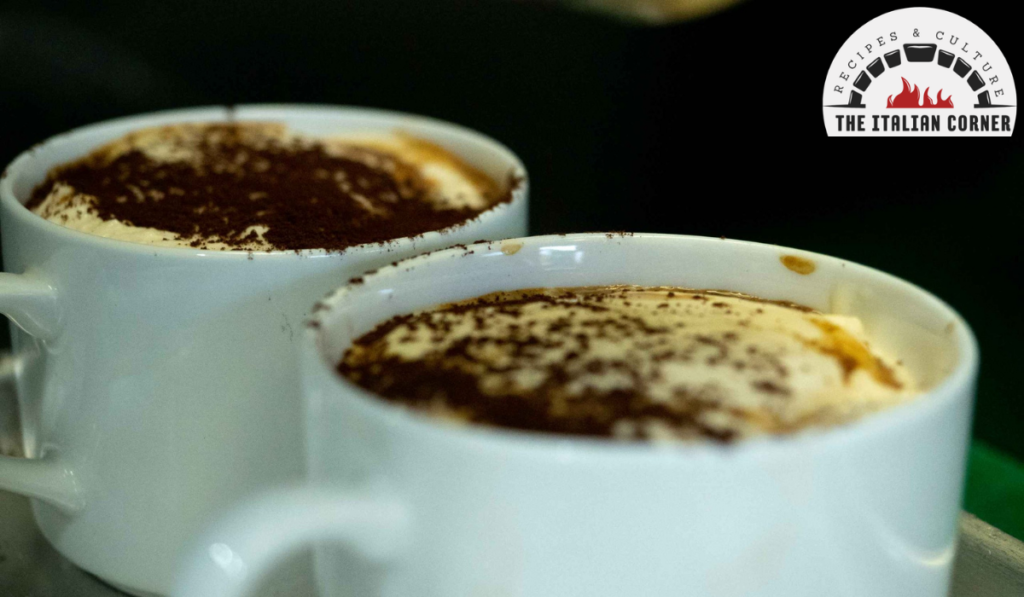
- Just before serving — not the night before, or it goes damp and muddy — dust the whole surface generously with cocoa through a sieve, and grate over dark chocolate if you’re using it. Cut squares with a clean knife, or serve it in proud, collapsing spoonfuls. Both are traditional. Only one photographs well. Choose the one that eats better.
Chef’s notes — the honest bits
If the cream went grainy, you overworked the mascarpone or your zabaglione was still warm. Genuinely split? Sometimes a few tablespoons of cold cream folded gently through brings it back. Sometimes it doesn’t, and you’re having “deconstructed tiramisu,” which is a thing menus say when a chef is having a bad day.
The raw egg question: the warm zabaglione method gently cooks the yolks, which is exactly why I use it over the raw-yolk versions. Cooking for someone pregnant or immune-compromised? Take the mixture to 71°C on a thermometer during the whisking. A minute more at the stove, everyone eats.
Booze reality: Marsala in the zabaglione is classic; a splash of coffee liqueur in the coffee works too. Pick one home for the alcohol, not both — boozy cream and boozy coffee is how tiramisu becomes a hangover with cocoa on it. And for a kids’ table, leave it out entirely; the espresso stays, the “pick me up” survives.
It holds three days in the fridge and day two is the best day of its life. Freezing works better than you’d expect — cut portions, wrap well, thaw overnight in the fridge — a line-cook trick for when the section over-prepped.
One dish, one dessert. Individual glasses look like a food blog circa 2014 and dry out at the edges. The big dish, the big spoon, the fight over the corner piece — that’s tiramisu.
Ribbon, fold, count to two, wait a day. Four disciplines, no oven, and the most requested dessert in your repertoire from here on. Ask me how I know.