
The first tray of ravioli I ever made for service blew up in the pot. All forty of them. Little air pockets I hadn’t pressed out expanded in the boiling water, split the seams, and sent ricotta drifting through the pasta water like a snowstorm. The chef made me fish out every ghost of a wrapper before I could start again — and then he showed me the thumb-press that has kept every raviolo I’ve sealed since intact. Twenty seconds of technique, ten years of dividends.
That’s ravioli in a nutshell. It looks like advanced pasta. It’s actually three simple jobs — dough, filling, seal — and one of them fails for almost every home cook for a reason nobody tells them. Here’s all three, done the professional way, scaled back to a Sunday afternoon at home.
Why bother, when the fridge section exists
Fair question. Supermarket fresh ravioli is fine for a Tuesday. But the filling in a mass-produced raviolo is maybe a third of the parcel, padded with breadcrumb and starch so it survives machinery and shelf life, and the pasta is rolled thick enough to take a forklift. Handmade ravioli inverts the ratio: pasta thin enough to see your fingers through, filling generous enough that it’s the point. You eat one and understand why Italians serve them as a course on their own, sauced with nothing more than butter and sage. That’s the payoff, and it’s worth an afternoon.
One opinion before we start, and I’m firm on it: your first ravioli should be ricotta and spinach. Not pumpkin, not braised meat, not anything that needs cooking down first. Ricotta and spinach teaches every skill with the fewest moving parts, and the filling problem it forces you to solve — moisture — is the exact lesson that makes every future filling work.
The technique: moisture is the enemy
Here’s what’s actually happening when ravioli go wrong, and it’s nearly always water.
Wet filling soaks into raw pasta and turns the seal to paste before the parcel ever hits the pot. Then in the boil, steam pushes at any trapped air pocket while the soggy seam gives way — and you’ve got my snowstorm. Every professional ravioli station is built around drying things out:
- Drain the ricotta. Tub ricotta from the supermarket is 20 per cent whey. Sit it in a sieve lined with paper towel for an hour, or overnight in the fridge. Better: buy firm ricotta cut from the wheel at the deli counter — most Woolies and Coles delis have it, and every Italian grocer does.
- Squeeze the spinach like it owes you money. Blanch it, cool it, then wring it in a clean tea towel until nothing comes out. Then wring it again. A fist of cooked spinach should be a dry, dense ball.
- Press the air out when you seal. Cup the filling with the top sheet, then press with your thumbs from the filling outward, chasing air to the edges before you press the seam shut. Air pockets are tiny bombs. Evict them.
Do those three things and ravioli become nearly foolproof. Skip them and no amount of fancy dough will save you.
The dough, without mythology
Pasta dough is flour and egg, kneaded until smooth, rested until relaxed. For ravioli you want it silky and strong: 100 g of flour to 1 egg, per person. Tipo 00 flour rolls the finest — Woolies and Coles both stock it now, usually near the specialty flours — but plain flour makes honest ravioli too, so don’t let a shopping trip stop you. The rest, the well on the bench and the fork and the flour everywhere — is theatre. A food processor brings the dough together in thirty seconds and the pasta cannot tell the difference. I resisted that shortcut for years out of pride. I was wrong.
The non-negotiable is the 30-minute rest, wrapped, at room temperature. Kneading winds the gluten tight; resting lets it slacken so the dough rolls thin instead of springing back at you. Rushed dough fights you the whole way. Rested dough behaves.
Roll it until you can read a newspaper headline through it — setting 7 of 9 on most machines, or patient work with a long rolling pin. Remember the parcel is two layers, plus four at the seams. What feels too thin flat on the bench is right once it’s folded.
Ricotta and spinach ravioli, burnt butter and sage
Serves 4 as a main (about 40 ravioli)
Dough
- 400 g tipo 00 flour (or plain flour)
- 4 large eggs
Filling
- 500 g firm ricotta, drained (deli counter if you can, drained tub if not)
- 250 g spinach, blanched and wrung bone-dry (a 250 g bag of baby spinach works)
- 50 g finely grated Parmigiano Reggiano or Grana Padano
- A whole nutmeg, for grating
- Salt
To finish
- 150 g butter
- A generous handful of sage leaves
- More grated parmesan
Method
- Make the dough: flour and eggs in a food processor until it looks like wet sand, then tip out and knead 5 minutes until smooth as a river stone. Wrap, rest 30 minutes.
- Make the filling: chop the wrung-out spinach finely, then beat it with the ricotta, parmesan, a good grating of nutmeg and salt. Taste it — it should be seasoned enough to eat with a spoon, because pasta mutes everything. Chill until needed.
- Roll a quarter of the dough at a time into a long sheet, thin enough to see your hand through. Keep the rest wrapped; naked dough crusts over in minutes.
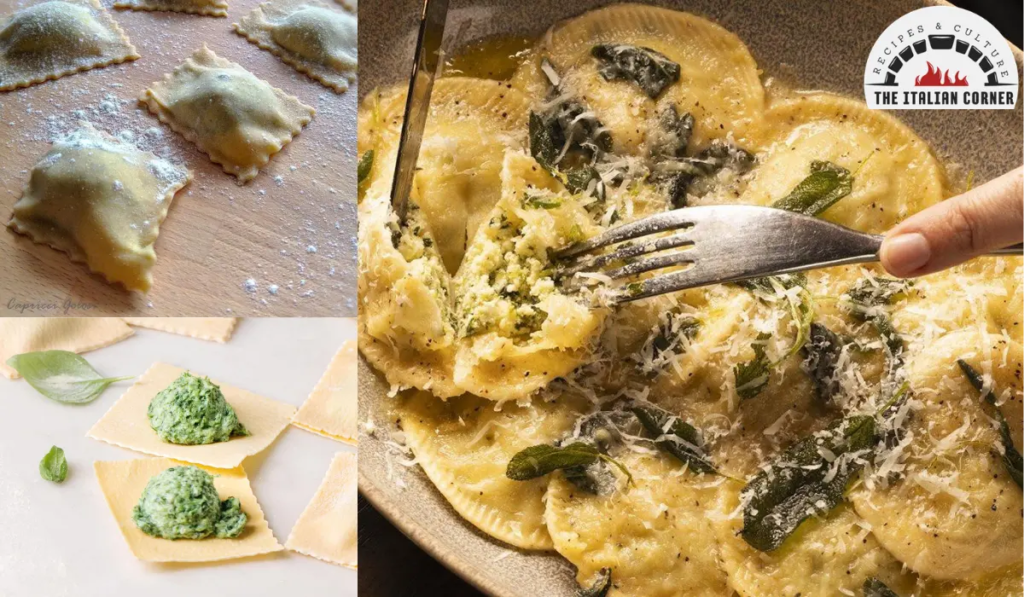
- Pipe or spoon walnut-sized mounds of filling along one half of the sheet, 4 cm apart. Brush around them lightly with water, fold the other half over, then thumb-press around each mound from the centre outward — chase the air to the edge before you seal. Cut with a knife, wheel or cutter.
- Line them up on a well-floured tray, not touching. They’ll hold a few hours in the fridge like this, or freeze solid on the tray then bag them.
- Boil in well-salted water for 3 minutes — they’re done shortly after they float and the edges turn tender. Meanwhile, melt the butter in a wide pan over medium heat with the sage until the butter foams, the sage crisps, and the solids turn the colour of toast and smell like hazelnuts. Off the heat.
- Lift the ravioli straight into the butter with a slotted spoon, bringing a spoonful of pasta water with them. Swirl the pan — the water and butter tighten into a glaze. Plate, parmesan, done.
Chef’s notes — the honest bits
A few will break. Budget for it. Even on the line we lost the odd one. Make four more than you need and boil the ugliest first as your tester.
Freeze, don’t refrigerate overnight. Raw ravioli left 24 hours in the fridge go grey and gluey where filling meets pasta. Frozen, they keep a month and cook from frozen in 4 minutes. Freezing is the better make-ahead, not the compromise.
Don’t crowd the pot. Ravioli in a rolling scrum tear each other. Wide pot, gentle boil, one layer’s worth at a time.
No pasta machine? Halve the recipe and roll with a pin. Your forearms will complain and your ravioli will be slightly rustic. They’ll still beat anything from the fridge section.
Once the seal is in your hands, the fillings are an open door — pumpkin and amaretti in autumn, braised beef cheek in winter. Same dough, same thumb-press, different Sunday.