
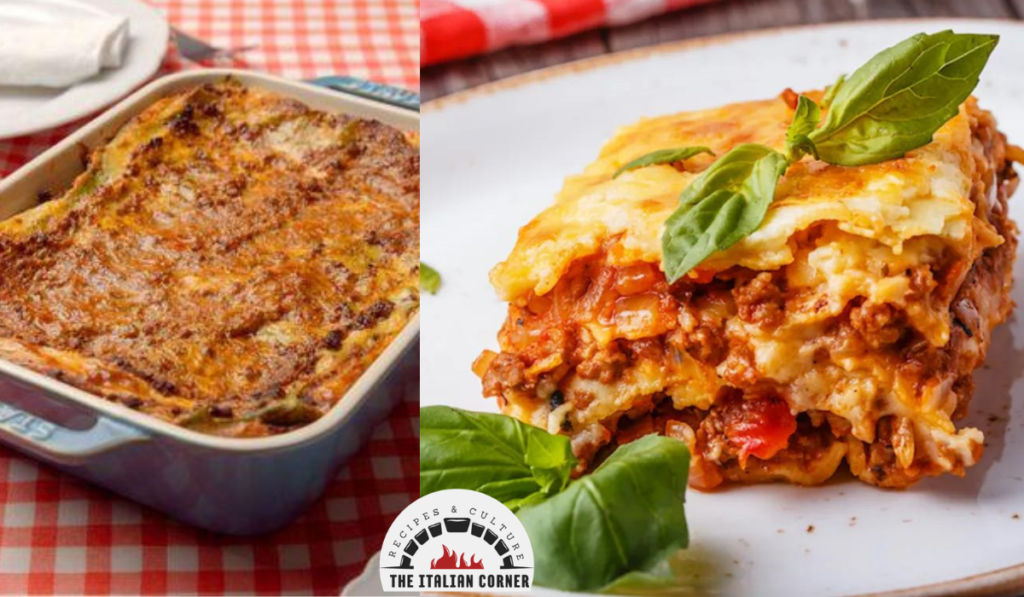

Every Sunday for two years, my job included portioning the lasagna for service — forty covers’ worth, cut with a ruler, and every piece had to stand up on the plate like a slice of building. The first tray I ever built myself collapsed the moment the knife went in. Sauce everywhere, sheets surfing away from each other, a delicious landslide. The sous chef looked at it and said the sentence I’ve repeated to every home cook since: “You built a swimming pool. Build a wall.”
That’s the entire secret of lasagna, and almost nobody tells you. It’s not a casserole with pasta in it. It’s masonry — thin layers of pasta as the bricks, sauce as the mortar — and once you build it that way, everything else (the sogginess, the sliding, the dry corners, the soup in the middle) fixes itself.
What a real lasagna is
The benchmark is lasagne alla bolognese, from Emilia-Romagna: sheets of pasta, slow-cooked meat ragù, besciamella, parmesan. That’s the list. No ricotta — that’s the American Southern-Italian branch of the family, a different dish wearing the same name. No sliced deli ham, no boiled egg, no pool of mozzarella an inch deep. The Bolognese version is restrained, savoury, and structural, and it’s the version worth learning first because it teaches the architecture. Once you own the architecture, put whatever you like between the sheets.
And on spelling, since Australia can’t decide: lasagna is one sheet, lasagne is the dish (plural sheets). Call it what your family calls it. The oven doesn’t care.
The technique: build a wall, not a pool
Here’s what’s actually happening in a collapsing lasagna. Pasta sheets are waterproof-ish when raw; in the oven they need to absorb moisture from the layers around them to cook and to fuse with them. If your layers are thick and wet — a swimming pool — the sheets float, steam, and stay slippery, so the finished dish is loose strata with nothing bonding them. If the layers are thin and the sauce is rich rather than watery, the sheets drink exactly what they need, starch and sauce weld each layer to the next, and you get a slab that cuts clean.
Four rules of the wall, stated plainly:
- Ragù cooked until the liquid is gone. The spoon dragged across the pot should leave a dry trail that fills slowly. Watery ragù is the number-one cause of sliding lasagna. Cook it out — it takes as long as it takes, and it’s mostly unattended.
- Thin layers, more of them. Just enough ragù to cover the sheet — you should half-see pasta through it — then a modest lattice of besciamella. Aim for five to six pasta layers in a standard dish, not three thick ones. Thin layers bond; thick layers slide.
- Sheets never touch sheets dry. Every sheet needs sauce contact on both faces, edge to edge, or you get those crunchy raw corners. Sauce right into the corners of the dish. Always.
- Rest it 25 minutes out of the oven. Straight from the oven, the melted starch and dairy are liquid; as it cools they set and the wall becomes a wall. On the line we baked lasagna hours before service and reheated portions — that’s why restaurant lasagna stands up and yours slides. The rest isn’t optional. It’s the mortar curing.
Sheets: fresh, dried, or instant?
Honest answers for Australian shelves. Instant (no pre-boil) dried sheets — San Remo and Barilla at Woolies and Coles — are what I’d tell most home cooks to use, and rule number one above matters double with them: they cook entirely on moisture stolen from your sauce, so a slightly loose besciamella is your friend. Fresh sheets (Latina in the fridge section, or your own if you’ve read my ravioli post — same dough, rolled one setting thicker) give the silkiest result and need no boiling either. Old-style boil-first dried sheets are honest too, just fiddlier; blanch them two minutes, drape them over the colander’s edge so they don’t glue themselves into a fist. All three make proper lasagna. The architecture matters more than the brick.
Lasagne alla bolognese
Serves 8, in a deep 33 × 23 cm dish
Ragù
- 2 tbsp olive oil
- 1 onion, 1 carrot, 2 celery stalks, all finely diced
- 500 g beef mince and 250 g pork mince (ask the butcher; the pork carries flavour beef can’t)
- 2 tbsp tomato paste
- 250 ml red wine
- 2 × 400 g tins whole peeled tomatoes, crushed
- 250 ml milk — the old Bolognese trick; it softens the meat and rounds the acidity
- Salt
Besciamella
- 100 g butter, 80 g plain flour, 1.2 litres warm full-cream milk, nutmeg, salt
To build
- 300–375 g lasagna sheets
- 120 g grated Parmigiano Reggiano or Grana Padano
Method
- The ragù: sweat the onion, carrot and celery in the oil over medium heat until soft and sweet, about ten minutes. Add both minces and cook, breaking them up, until the liquid they release has evaporated and the meat starts to sizzle and catch — that browning is flavour, wait for it.
- Stir in the tomato paste for a minute, then the wine; let it bubble away to almost nothing. Add tomatoes, milk and salt, then simmer, lid ajar, on the lowest flame for 2–3 hours, stirring occasionally, until it’s thick, dark and glossy and the dry-trail test holds. This is the unattended part — fold the washing, watch the footy.
- The besciamella: butter and flour cooked two minutes to wet sand, warm milk whisked in thirds, simmered five minutes until it coats the spoon. Nutmeg, salt. Keep it slightly loose — pourable cream, not custard — especially with instant sheets.
- Build, 200°C oven waiting: a smear of besciamella on the base, then repeat — sheets, thin ragù, thin besciamella, dusting of parmesan — five or six times. Sauce into every corner. Finish with besciamella and a confident layer of parmesan, no naked pasta anywhere.
- Bake 35–40 minutes, until the top is gold with dark blistered patches and the edges bubble and hiss like something alive.
- Rest 25 minutes on the bench. Then cut with a sharp knife straight down — the piece should come out as a slab, layers visible like sediment. That’s the wall.
Chef’s notes — the honest bits
Lasagna is better tomorrow. An overnight-rested, refrigerated lasagna reheated in slices is superior to fresh-baked — the layers fuse completely. Every chef knows this; almost no dinner-party host exploits it. Build it Saturday, serve it Sunday, take the compliments.
The freezer loves it. Bake, cool, portion, freeze. Reheat covered at 160°C from frozen, 40 minutes. It’s the best fast food in your house.
Doubling the ragù is free. It’s three hours either way. Cook double, freeze half — that’s a future weeknight tagliatelle sorted.
If it still slid apart: your ragù was wet, your layers were thick, or you cut it at five minutes instead of twenty-five. It’s always one of those three. It was always one of those three for me, too.